
14 days to cancel, 2 years of cover: which rights actually apply when you buy a deal
Cancellation, statutory guarantee and manufacturer warranty are three different things — and only two of them are yours by law. The deadlines, the exceptions, and what retailers add voluntarily.
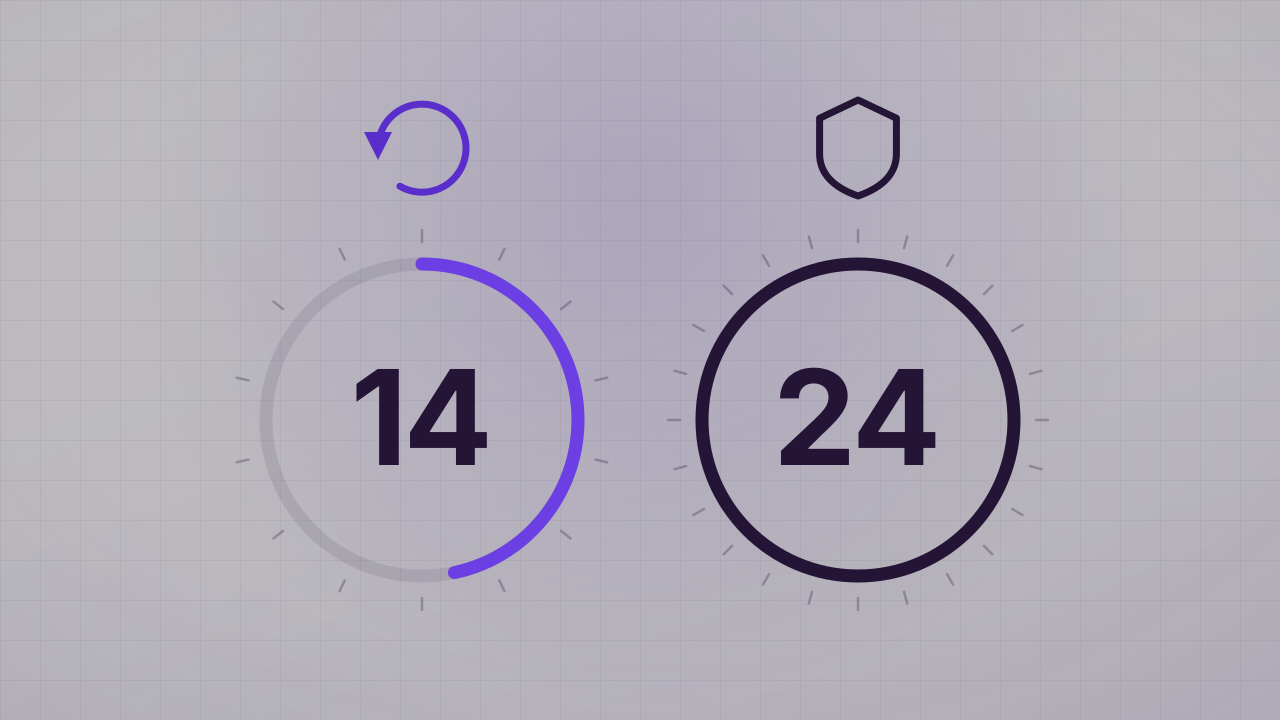
A good deal only becomes a good purchase if you can undo it. And that is exactly where things get muddled: three different legal concepts get thrown together in everyday use, two of them are guaranteed by law, one is entirely voluntary — and the generous return windows most people take for granted belong to the voluntary category. Here is the sorting.
Three layers that have nothing to do with each other
The right to cancel. Applies to distance purchases — online, by phone, from a catalogue. You may unwind the contract without giving a reason. The item does not have to be faulty; you are simply allowed not to like it. Across the EU this is harmonised at a minimum of 14 days, and the UK keeps an equivalent 14-day cancellation right under its consumer contracts rules.
The statutory guarantee. Applies when goods have a defect that was already present at handover. This is not about taste, it is about faults. The claim is always against the retailer, never the manufacturer. For new goods the EU minimum is two years; in the UK the equivalent protection runs through the Consumer Rights Act, which additionally gives you a short-term right to reject faulty goods within 30 days.
The warranty. A voluntary promise, usually from the manufacturer. It can be more generous than the statutory guarantee — three or five years on some electrical goods — or as little as twelve months. It may never replace your statutory rights, only add to them. If a seller advertises "12 months warranty" and concludes that this is the end of it: wrong.
The 14 days: when they start and what they cost
The period does not begin with the order but with receipt of the goods. Where a delivery arrives in several parcels, the last item generally counts. A clear statement within the period is enough to cancel — sending it is what matters, the goods themselves may still be travelling afterwards.
Two points that regularly cause friction:
Inspecting is allowed, using is not necessarily. You may examine the goods as you could in a shop — unpack, look, try on. Go beyond that and cause a loss in value, and you can be liable for a proportion of it. In practice large retailers handle this generously; you have no claim to that generosity.
Return postage is the retailer's decision. By law they may pass it on to you, provided they said so in the cancellation policy. That the big platforms usually absorb it is a competitive choice — not a right.
The exceptions worth knowing before you click
For some categories the right to cancel falls away entirely or once the item is opened:
- Sealed goods for health or hygiene reasons, once the seal is broken — cosmetics, earplugs, underwear, mattresses in protective film.
- Sealed audio, video and software media after opening.
- Custom-made and individually configured products — from an engraved gift to a computer built to order.
- Perishable goods.
- Digital content without a physical medium, where you expressly agreed to immediate performance and thereby waived cancellation.
That last point deserves a second look: the waiver is often collected in a casually placed checkbox. The Court of Justice of the European Union has since significantly restricted the practice of demanding such a waiver from consumers as a matter of routine.
Statutory cover: the two years and their key mechanism
If a defect appears within two years that the goods already carried in embryo at handover, the retailer must repair or replace. The sticking point is normally proof — and that is arranged in your favour: for an initial period after purchase, the defect is presumed to have existed from the start, and the retailer would have to prove otherwise. Since the EU sale of goods directive was implemented this reversed burden of proof lasts at least twelve months, and longer in some member states.
For used goods — for example when buying returns — the period may be contractually shortened to one year. It does not disappear. And a defect is not the same as a described used condition: a disclosed scratch is not a defect, an undisclosed fault is.
Why the generous windows are shrinking
Many retailers grant considerably more than the statutory 14 days — 30 days has long been the norm online, often more over Christmas. Those voluntary windows are currently being pulled back in several places; Amazon has announced a reduction for part of its orders.
Two consequences for you. First: do not rely on a period you remember from before — it is set out in the terms of the specific order and may have changed. Second: nobody can shorten your 14 days. Anything beyond that is goodwill, and goodwill can be withdrawn.
What this means for buying deals
A discount changes none of these rights. Reduced goods are not "sale items with no right of return" — that phrase comes from bricks-and-mortar retail, where no cancellation right exists in the first place, and it gets carried over online where it does not belong. If you buy online, you buy with the same rights, percentage sign or not.
Three habits that make the difference: keep the order confirmation, because it is your proof of purchase for the full period. On marketplace purchases, check who your contracting party actually is — the platform operator or a third-party seller, because that is who your claims are addressed to. And with unfamiliar shops, check briefly beforehand whether the trader exists at all; how to spot that is set out in our guide to fake shops.
* Prices incl. VAT, plus shipping if applicable. Prices may have changed since the last update; the current price on the merchant’s site applies. Real-time updates are not technically possible.
About the author
Yahya Bolat
Redaktion · hyped4you
You might also like
Amazon Warehouse: What buying returns really saves — and when the condition grade misleads
Inspected returns with a condition discount are one of the steadiest ways to save. What the four grades mean in practice, where the discount is real and where the purchase becomes a lucky dip.
Spotting fake shops: 8 signals a fraudulent online store can barely hide
A price that exists nowhere else is rarely a find and often a trap. How to recognise a dishonest shop in under two minutes — and what to do once money has already moved.